Inside a $20M Ski-In/Ski-Out Masterpiece: Q&A with Nancy Jeffrey at 3005 Trails Edge
Ski Properties Nicole Montgomery September 30, 2026
Ski Properties Nicole Montgomery September 30, 2026
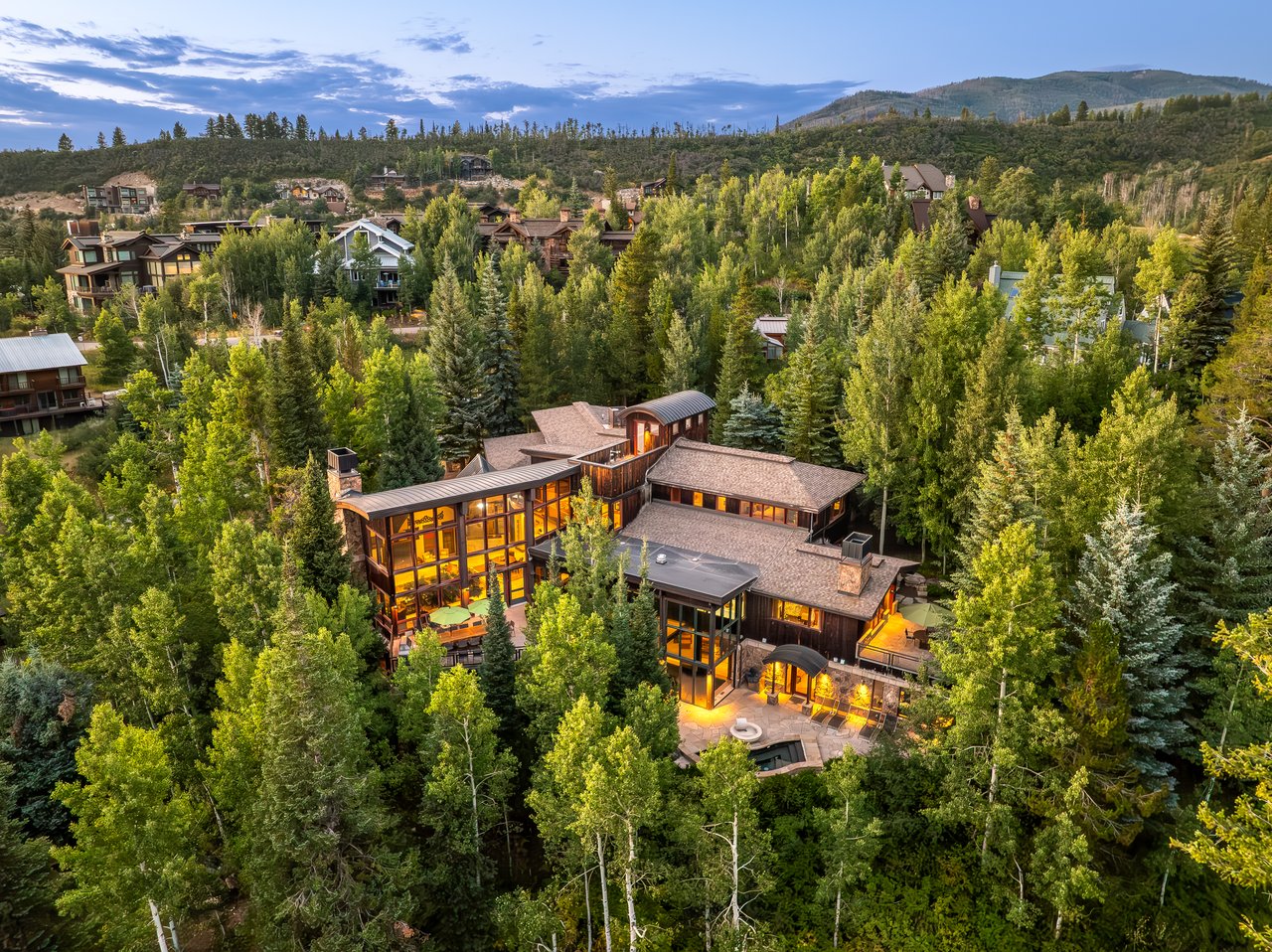
From the arrival, you cannot tell what lies within this mountainside estate. The house reads modestly from the street, tucked into the evergreens, understated, quiet. That is entirely intentional. Open the front door, and the forest opens with it, the ski runs visible through floor-to-ceiling glass, the slopes 50 feet away.
Recently showcased by Mansion Global, 3005 Trails Edge is one of fewer than ten single-family residences in the Steamboat Ski Area with ski-in/ski-out access. At nearly three-quarters of an acre, it represents a scale of slopeside landholding that current zoning simply will not allow again. This kind of estate, in this position, on this mountain, cannot be recreated. It spans 11,119 square feet with six ensuite bedrooms, a bunkroom, a 13-seat home theater, and an indoor-outdoor pool unlike anything else on this mountain. It is now offered for the first time at $20,000,000, represented by Chris Paoli.
Position and scale are not what make it irreplaceable. Designed by architect Bill Rangitsch of Steamboat Architectural Associates and built by Fox Construction, 3005 Trails Edge is the product of a design philosophy, an artist's eye, and 25 years of devoted ownership that treated the home not as a finished object but as a living work, continuously, intentionally evolved by the people who built it and never stopped caring for it.
We sat down with Nancy Jeffrey at the home itself. Jeffrey is an artist, interior designer, and founder of Defiance Clothing Co. and Studio2eleven, who splits her time between Steamboat and Glenwood Springs. She was brought onto this project before the foundation was poured and has never really left. Over nearly 90 minutes, she told us how 3005 Trails Edge came to be.
You've known the owners for over 30 years. How did this project begin?
A friend of a friend brought me in to do some hand-painted tile work for the family. I used to paint on pre-made tile, doing underglaze murals. That rolled into doing larger mural work at their home in Short Hills, New Jersey. And then they bought the property here. It was a teardown, tiny. We tried to save part of the foundation, but it never worked out.
They brought me up to New Jersey and said, "We want to know where you see yourself in this project." I laid it out for them: I can come in at the end and do what I was doing—the custom plaster, the murals—or I can start right now and hold your hand through the whole process. They chose the latter. This was the first house I ever did interior design on.
What did working with architect Bill Rangitsch teach you about approaching a house at this scale?
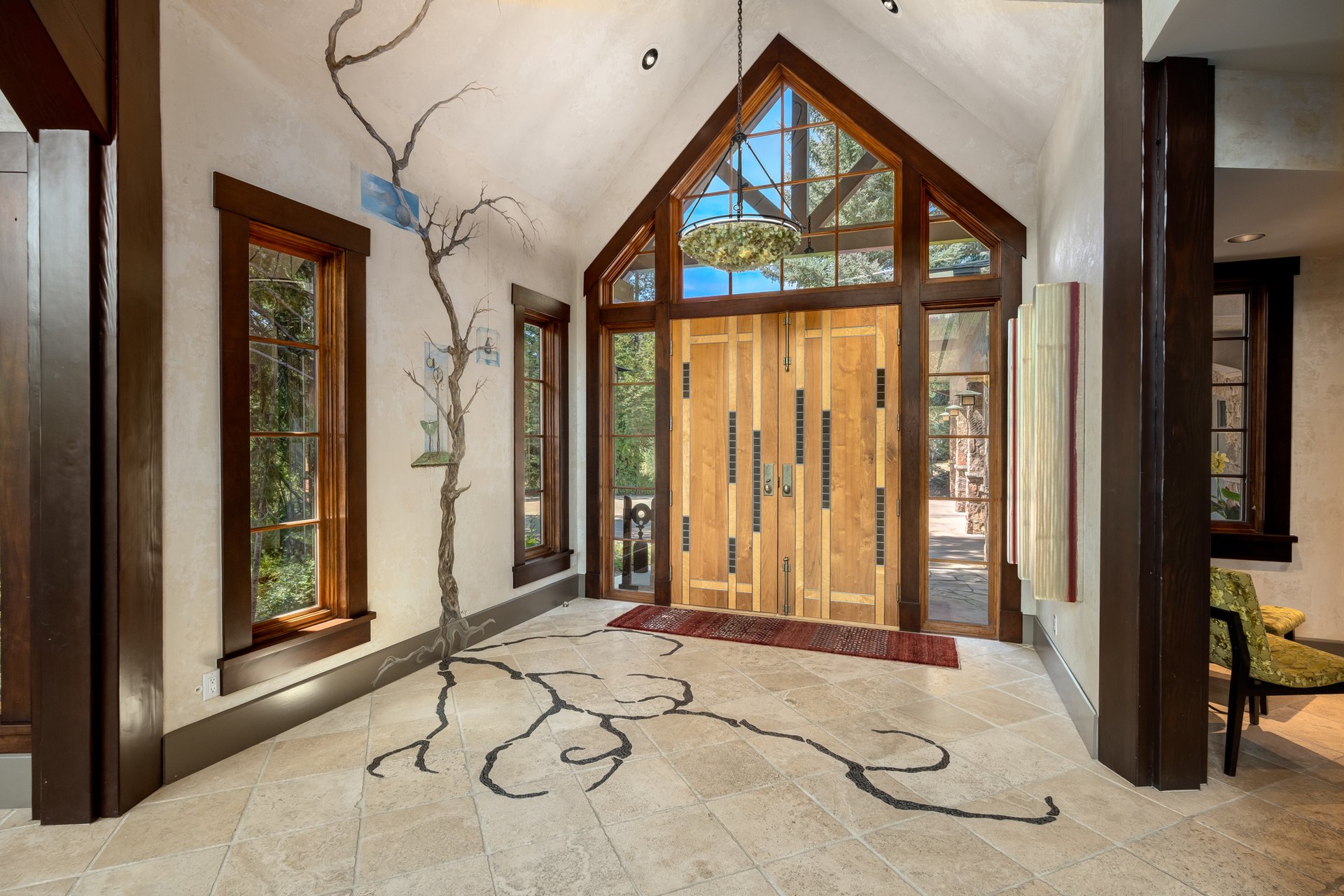
Every time we came out here to work, he would explain his thinking. He said: You want to create a memory as you go through a house this size. Reuse a design element. Let something anchor the whole. What I think really anchors this house is the millwork, the murals, the railings — all of that creates a beautiful consistency throughout. You're moving into new areas that have their own personality, but they still feel like part of the family. Bill explaining it that way made a lot of sense. And I feel like it's why the house still looks so right after 25 years.
The pool is the heart of this house in a lot of ways. How did that space come to define the architecture?
They knew the size of house they wanted, and they knew they wanted a pool. Bill had initially designed it on the lower level, more or less conventionally. But then the question came up: do we want it indoors or outdoors? And Bill and I started thinking about it together, and we landed on—couldn't it be both? A space that fully opens up?
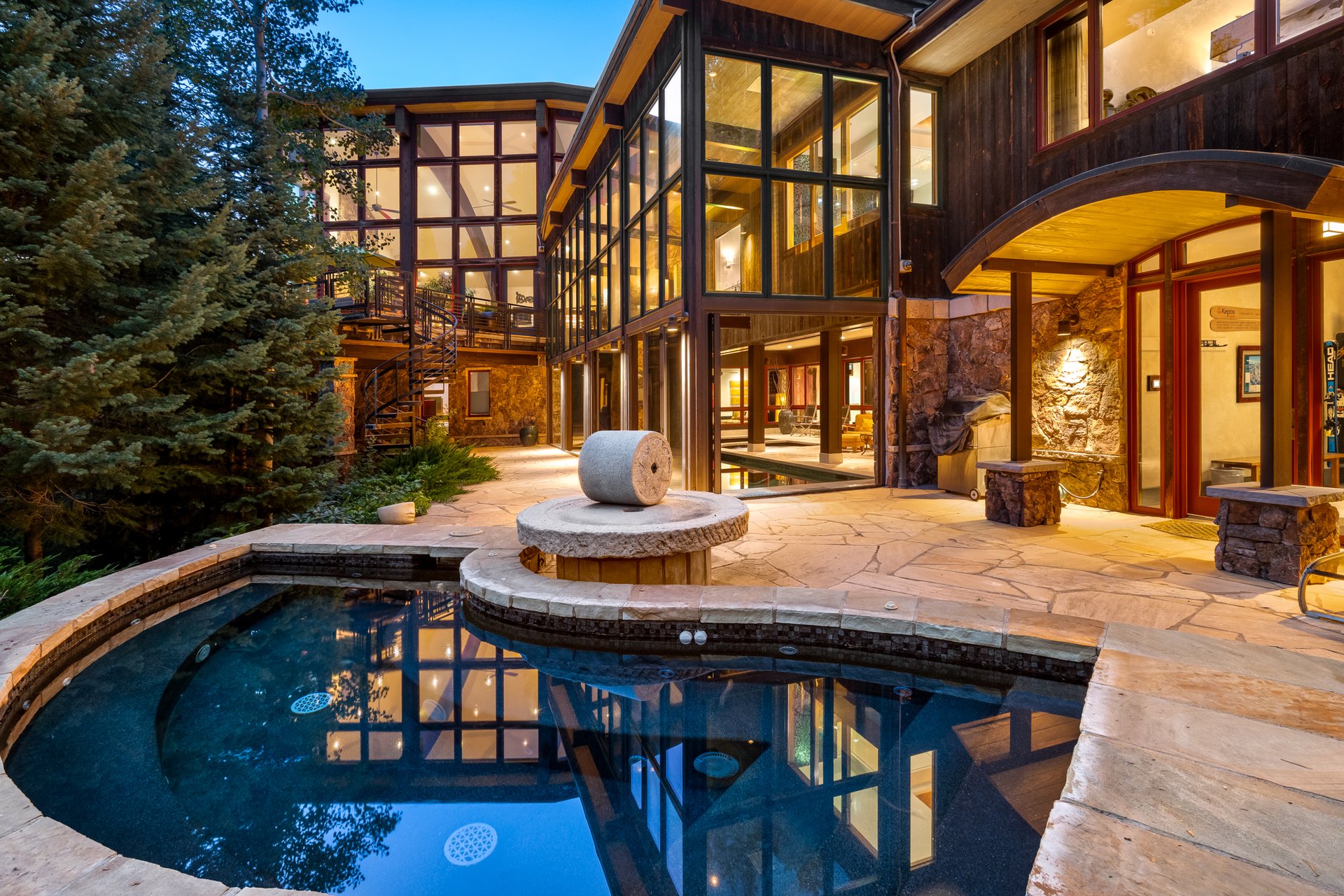
Back then, that kind of accordion door system was not common. No one in Steamboat had done it. So we found the companies that could execute it, and that decision drove the entire design of the house. Bill designed the pool space to look as though it was always meant to be an addition—like the house was finished and then they decided to close it in. All the materials in that space are exterior: the stone, the barnwood. It has outdoor finishes on the inside. And when those doors open in summer, the pool is fully open to the landscape. That concept, that one decision, changed the plan completely.
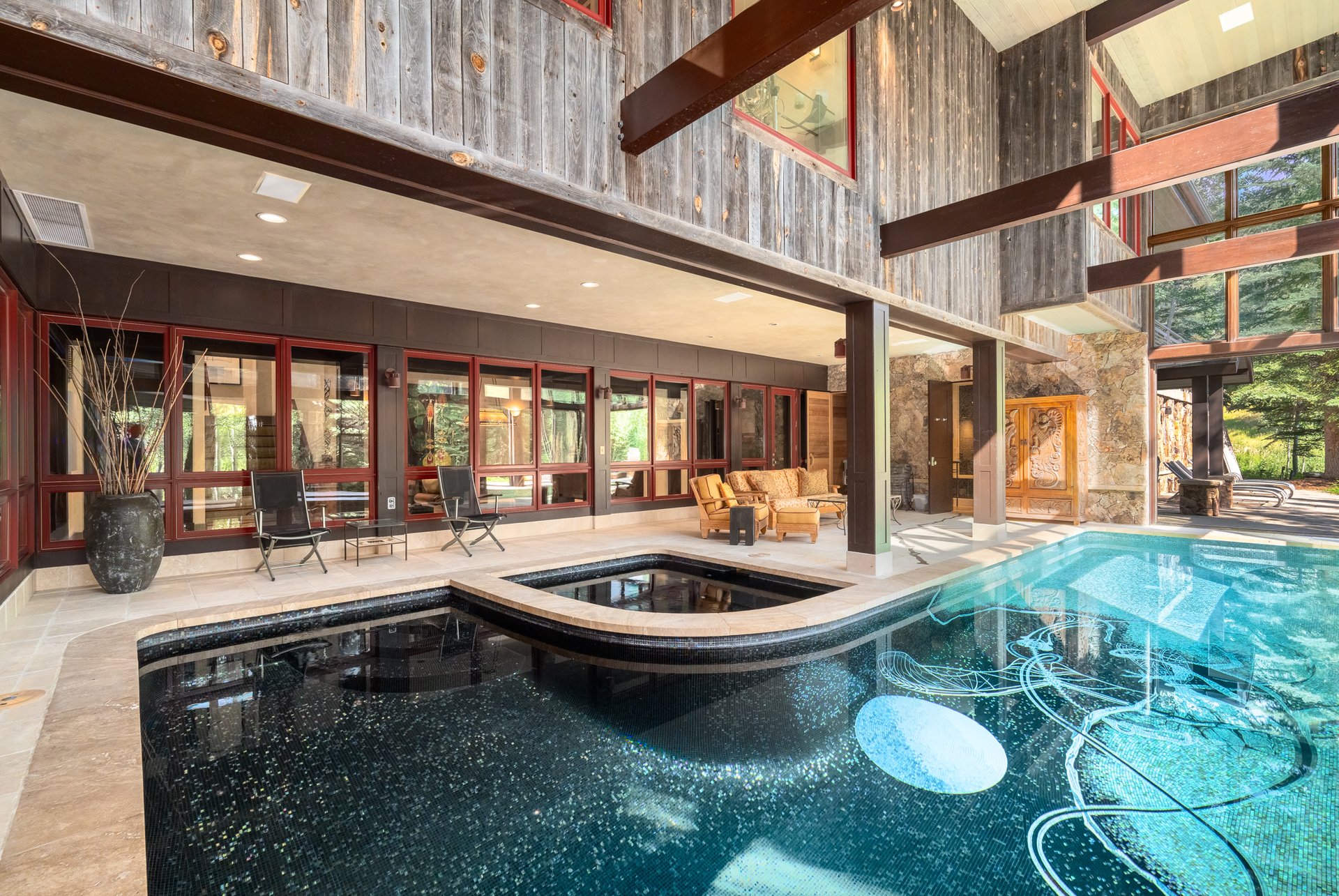
And the mural in the pool came out of that?
I had done a painting in 1997 called Sylph. The owner saw it and wanted to buy it, but it had sentimental value to me. I wasn't ready to let it go. When we started building, she said: Can you paint that painting in my pool? I said yes.
And Bill said: If there's going to be a mural in that pool, I need to redesign the house so you can look down and see it from above. So he opened up the sight lines from the main level. That's why the pool is visible from so much of the interior.
We painted that mural multiple times over the years, draining and repainting every few years as it wore. At one point, the owner had an idea: what if we did the mural in Sicis tile?
Sicis is a mosaic made from Murano glass and made in Italy; it’s an extraordinary product. We worked with Materials Marketing in Denver, who connected us with them. Before we demolished the painted pool, I went in and did full tracings of the mural. We rented an empty office space in the Chieftain building and laid the entire design out at full scale. Then we sent a package of 100 detailed photographs to the mosaic artists in Italy, so they could recreate the original painting in glass.
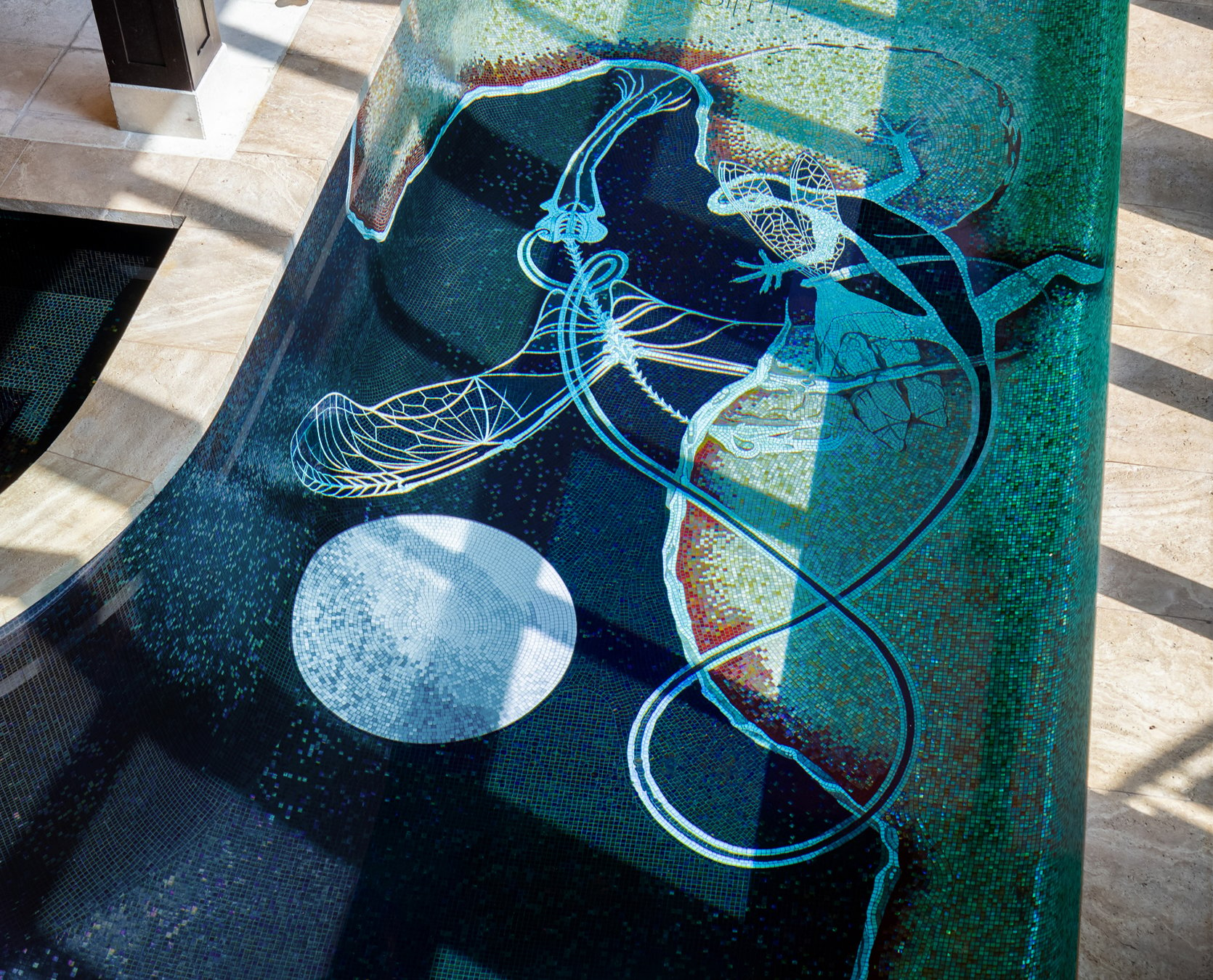
It shipped here by container—it crossed the ocean. We laid it out in the driveway first to check everything before it went into the pool. My husband, who originally built the pool, installed it. Mosaic installation is not for the faint of heart. You always have to rebuild sections. But what's in that pool now is a permanent record of a painting I made in 1997, rendered in Italian glass, and it will outlast all of us.
You described the tile schedule on this house as the most detailed you've ever done. What made it so complex?
It was my first time doing it. [Laughs.] We sourced tile in Denver, Washington D.C., and New York City. And even though the house has this somewhat modern sensibility, every single bathroom has multiple different tile pieces that make up the design. Each one is its own composition.
I also had this idea of creating a continuous plane, not stopping tile arbitrarily where a wall meets a floor, but treating an entire surface with a singular material. We ran tile out of showers and across entire walls. The result is so much more complete. It's a simpler vocabulary, actually. You're not seeing material stop here and start there, a half wall here, a border there. As an artist, I see things as a whole picture. That's how Bill sees architecture, too. He taught me to think that way about interiors.
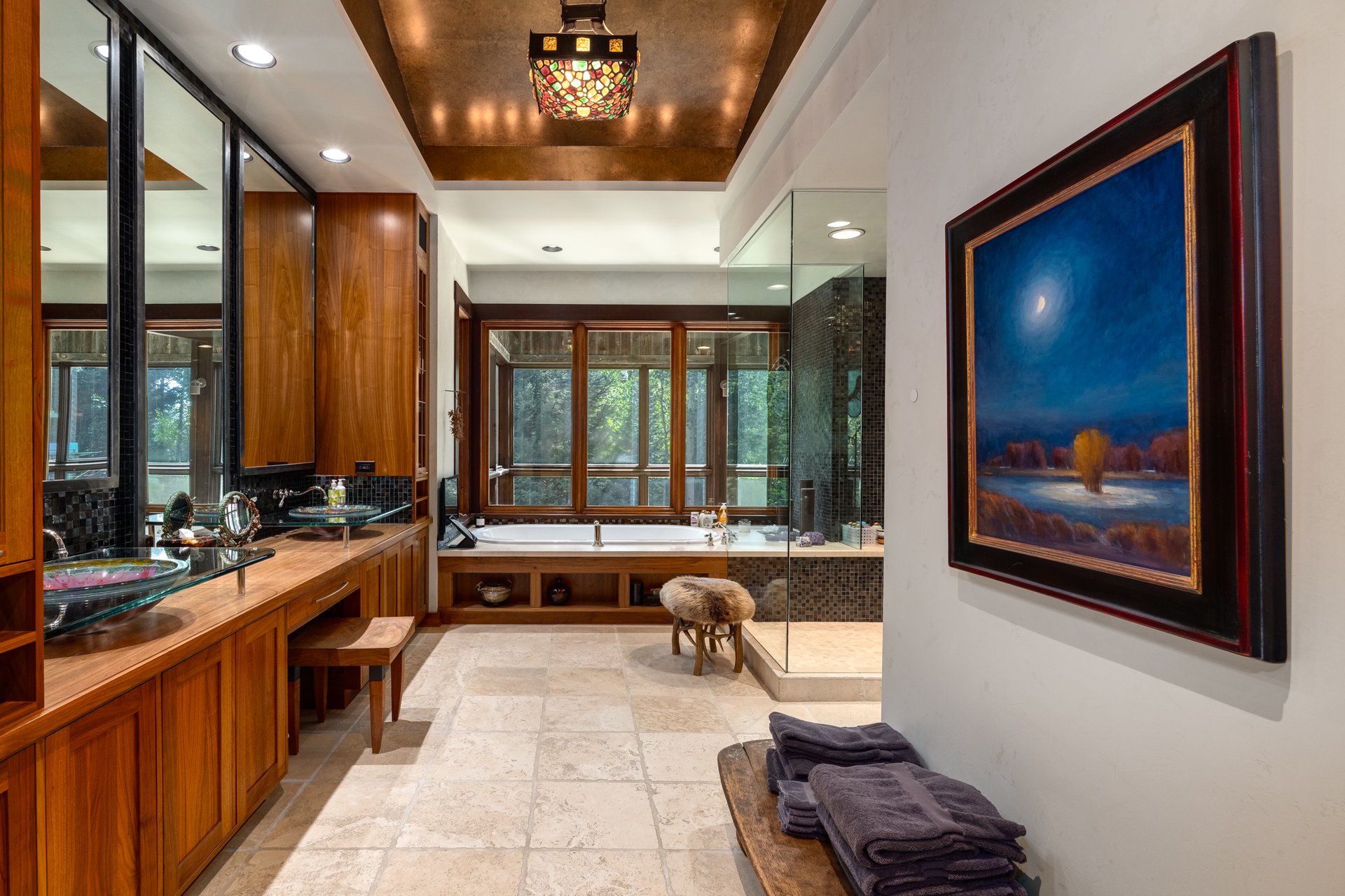
We also had metal bands built on-site by a welder in the powder room floor and framing the mirror. Those details are the kind of thing you don't notice consciously but feel right when you're in the space.
You brought a crew of artists here from D.C. Who were they?
Roger Preston was the main collaborator. He did the entry mural with me. I had a group of artists I worked with regularly in D.C., and Roger had pulled that crew together for bigger projects. They all came out here. We were in Steamboat for three months.
Everything on the walls was done by us. Every room has either custom plaster, glazing, or painted work. The hand-painted leaves in one of the bedrooms, the plaster throughout—all of it. Another fellow D.C. artist made the railing in the loft, the floor inlays, and the lighting on the stairwell—those were fabricated in D.C. and shipped here.
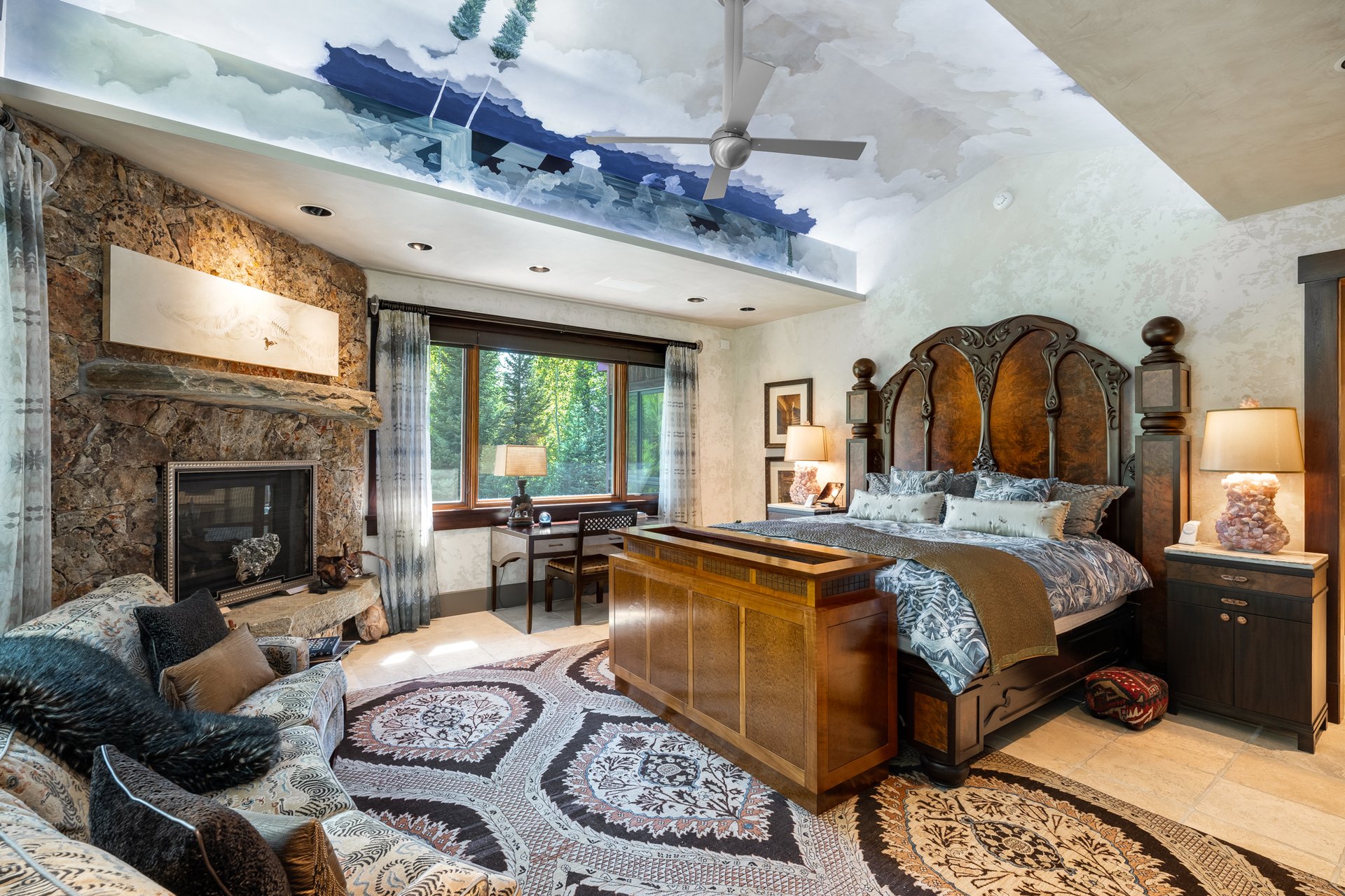
Bill put together a show at the Depot art space that fall, featuring all the artists who had worked on this house. Over the years, the owners have collected pieces from many of the artists.
Each bedroom has a distinct identity. How did you approach that?
Separately, really. One of the upstairs bedrooms is very traditional, almost entirely its own world. And that came from a single find. The owner and I were in New York City at a company called Urban Archaeology, and we found an antique tub—probably a hundred years old. We bought it for this house, had it shipped west, and it somehow ended up lost in California for a couple of months. When it finally arrived, the name on it was Carrie Grant. Misspelled, but old enough that we were like, this may well have come out of his apartment in New York City. That tub drove the entire design of that bathroom. It's why it feels so different from the rest of the house.
We used a neutral travertine throughout the whole home, floors, and walls, which was a new material for this area at the time. Most people in Steamboat were still using slate. By committing to it as a through-line, even the most traditional room in the house still feels connected to everything else.
The kitchen cabinetry by Ron Clow is remarkable. What's the story there?
Bill designed the kitchen layout. I worked on the finishes—the walnut, the tile selections. The original countertops were concrete, which was very new for countertops at the time. It looked interesting, but never felt quite right. Eventually, we were working on a home in New Jersey, and the owners fell in love with a honed limestone we were using there. She wanted to redo the Steamboat kitchen with the same material. We worked with Artistic Tile on the East Coast—they're sold through Decorative Materials in Denver—and brought the slabs out here.
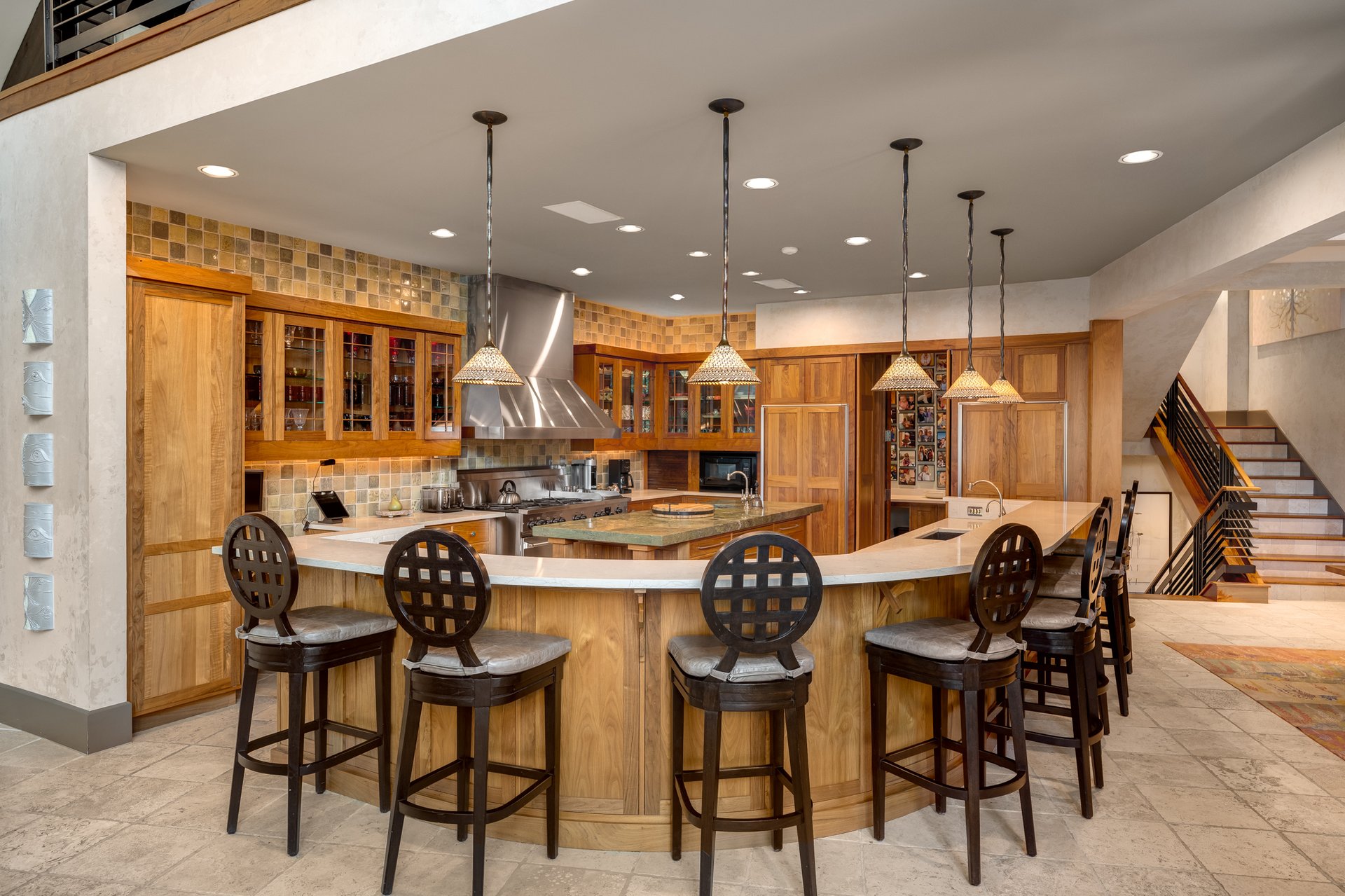
The island has its own character—it's a marble granite with a built-down edge so it reads almost like a piece of furniture. That island has its own weight and presence in the room.
That's very much how this house has always worked: whatever didn't stand the test of time, we replaced or refined.
What has only gotten better with time?
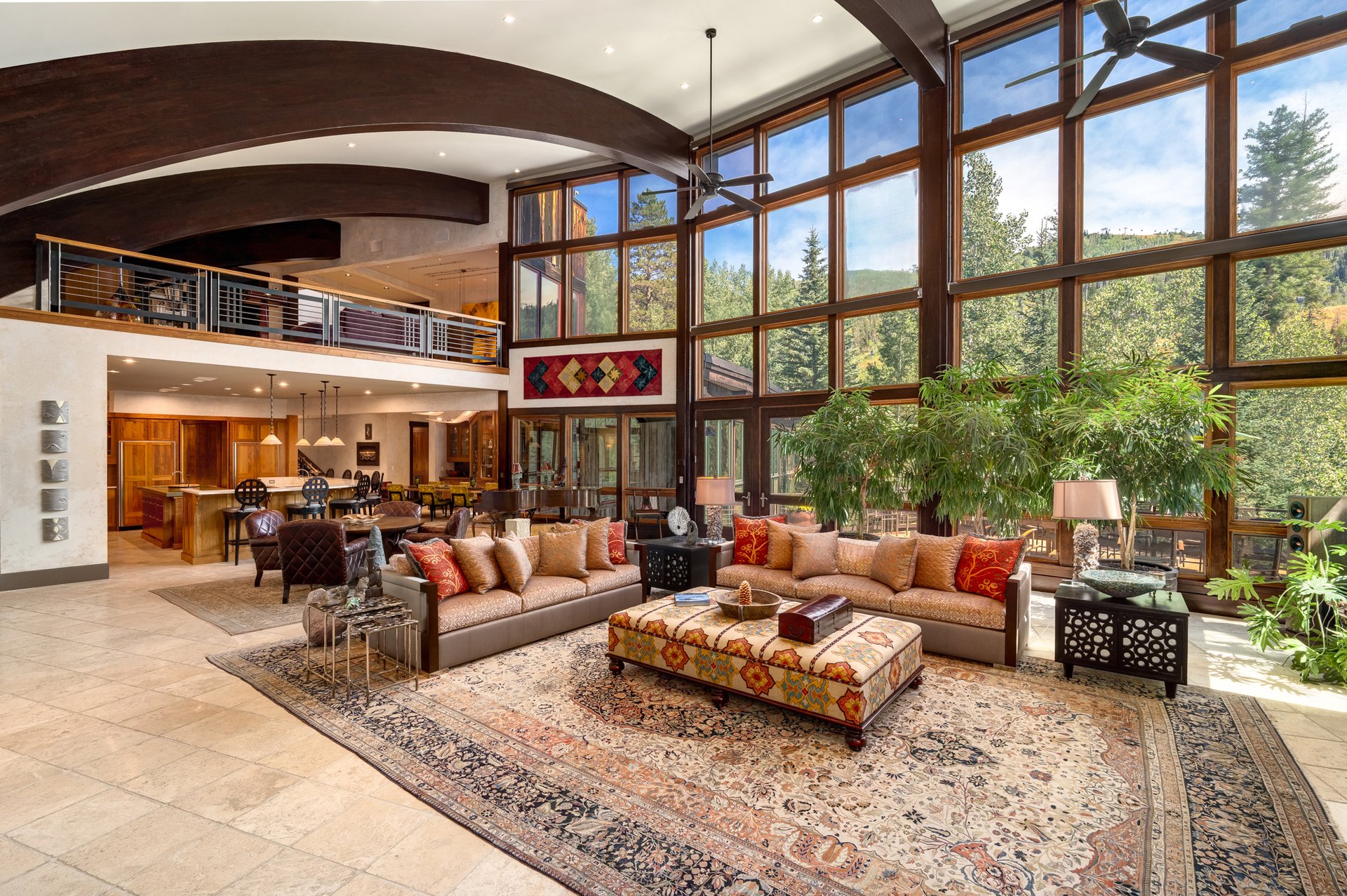
The consolidation. The owners sold two homes in New Jersey over the years—one at the shore, one in Short Hills—and when they did, we took the very best of everything and brought it here. The light fixtures over the kitchen island were in a New Jersey house. The rugs. A Steinway grand—an antique from a New Jersey house, which replaced a newer one that was here. A custom billiards room light fixture I designed for their New Jersey home came here. The Pucci dining table. Italian glass fixtures over the table. Textiles I designed that we used in the primary bedroom—they completely changed the character of that room.
When you consolidate the best of several homes into one, the result is something that a new build simply cannot replicate. The furnishings here are not an afterthought.
What do you want someone to understand about this house that a brochure or photographs can't convey?
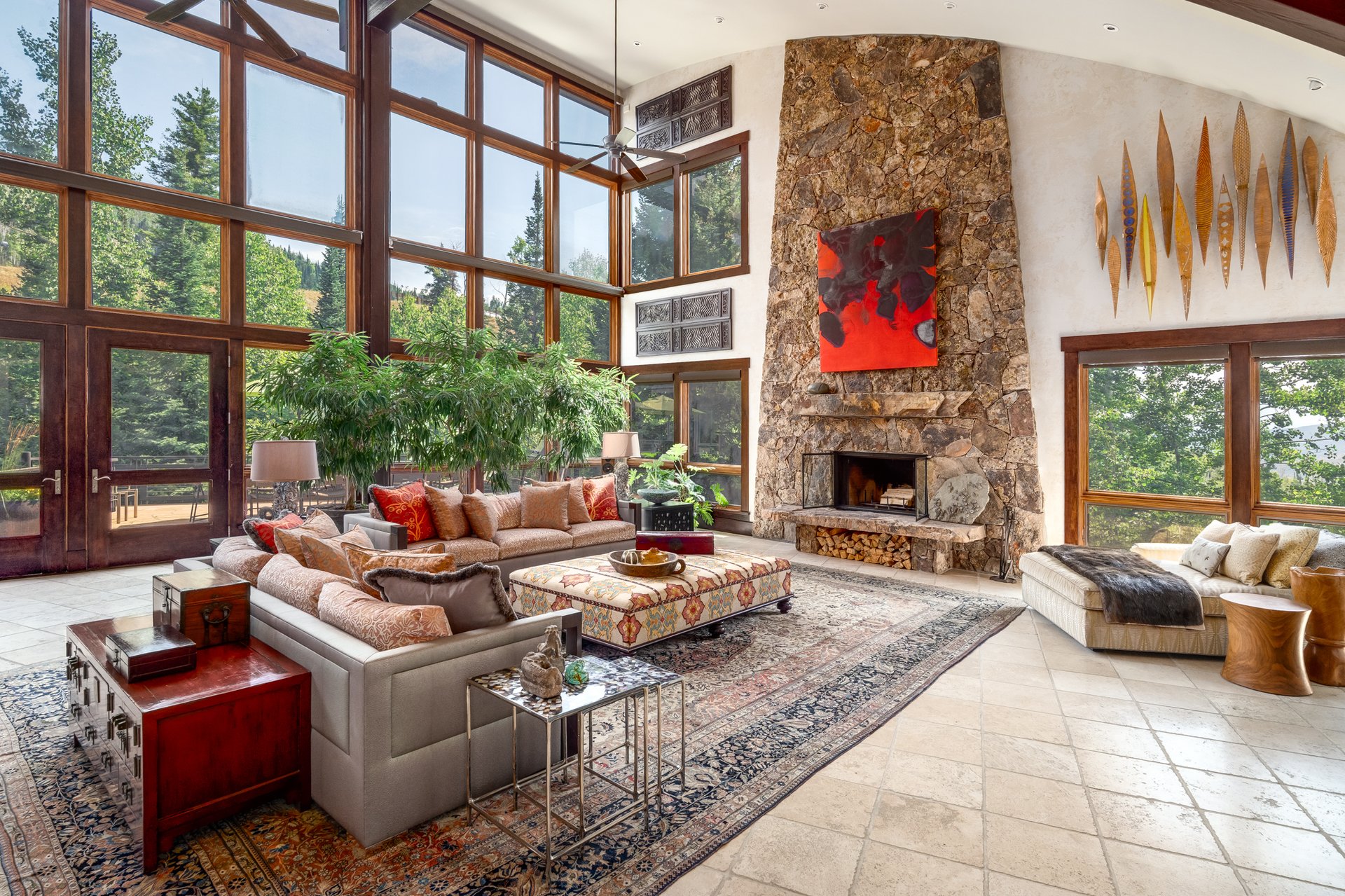
You have to be inside it. We went to great pains to make rooms that feel intimate and comfortable within a genuinely grand space. When you walk in, you see the scale, but it doesn't feel cold or untouchable. It's meant to be lived in and touched. I always touch walls when I walk through a house—and in this house, you want to.
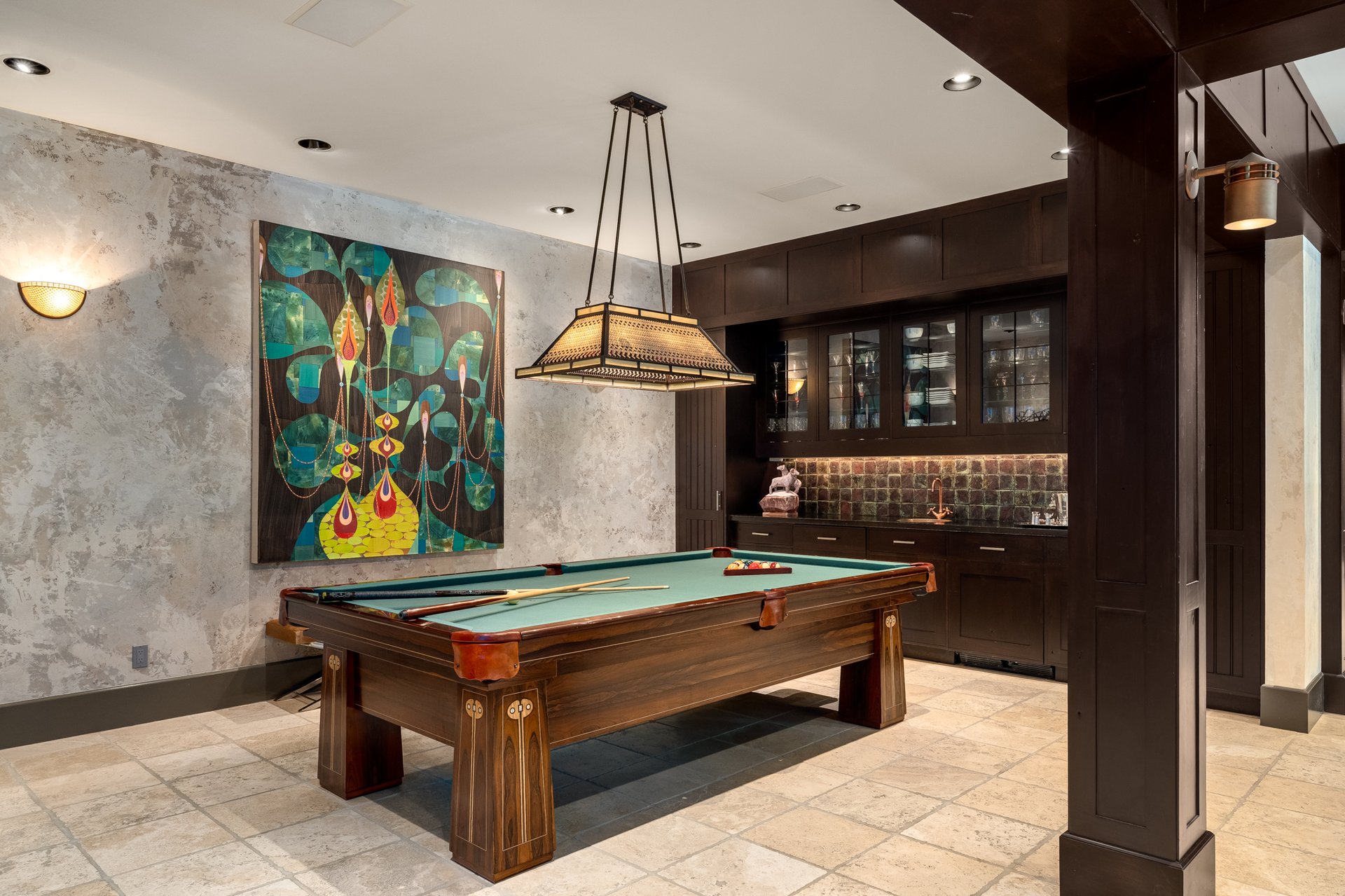
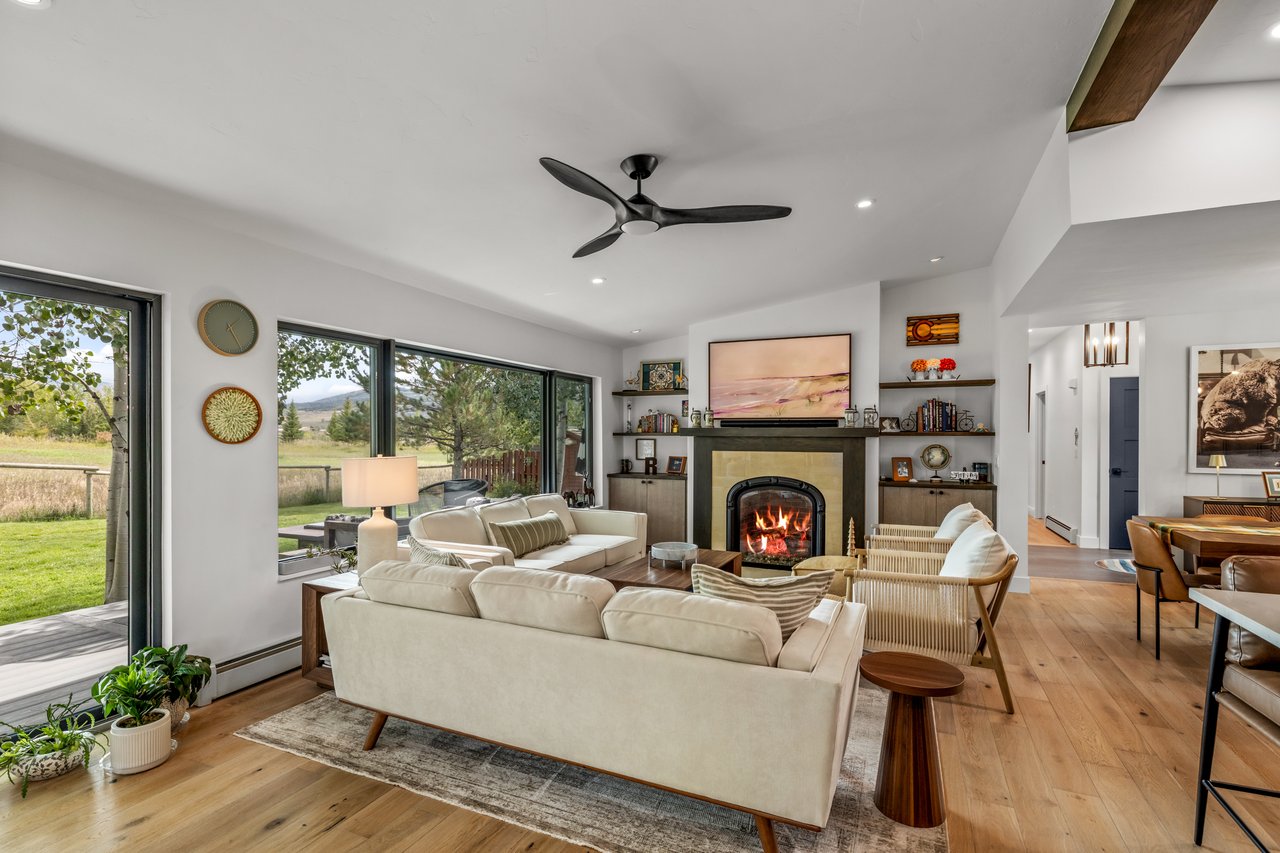
There's also this series of common areas that just work. The loft upstairs, the gathering spaces on the lower level. Whenever I come over, and the owners have a group here, there are always people up in that loft. And then every guest retreats to a beautiful ensuite bedroom. That combination—real common areas for gathering, and real privacy for sleeping—is harder to achieve than it sounds. This house does it.
It's also a genuinely great kitchen to cook in. Not a show kitchen. One of the owners’ friends brings his own pot when he visits. People love being in that kitchen. And the house is incredibly private for being right on the ski area. The evergreen screen around the property means you're in the forest, not on display. You'd never know from the slopes what's behind those trees.
3005 Trails Edge is offered at $20,000,000, and represented by Chris Paoli. The property is being offered fully furnished. For more information and access to the full video and property brochure, visit theagencysteamboat.com/3005-trails-edge. Contact [email protected] for a private showing.
Stay up to date on the latest real estate trends.
Market Insight
From a creekside refresh to a downtown addition, six Steamboat listings where the updates are already in place.
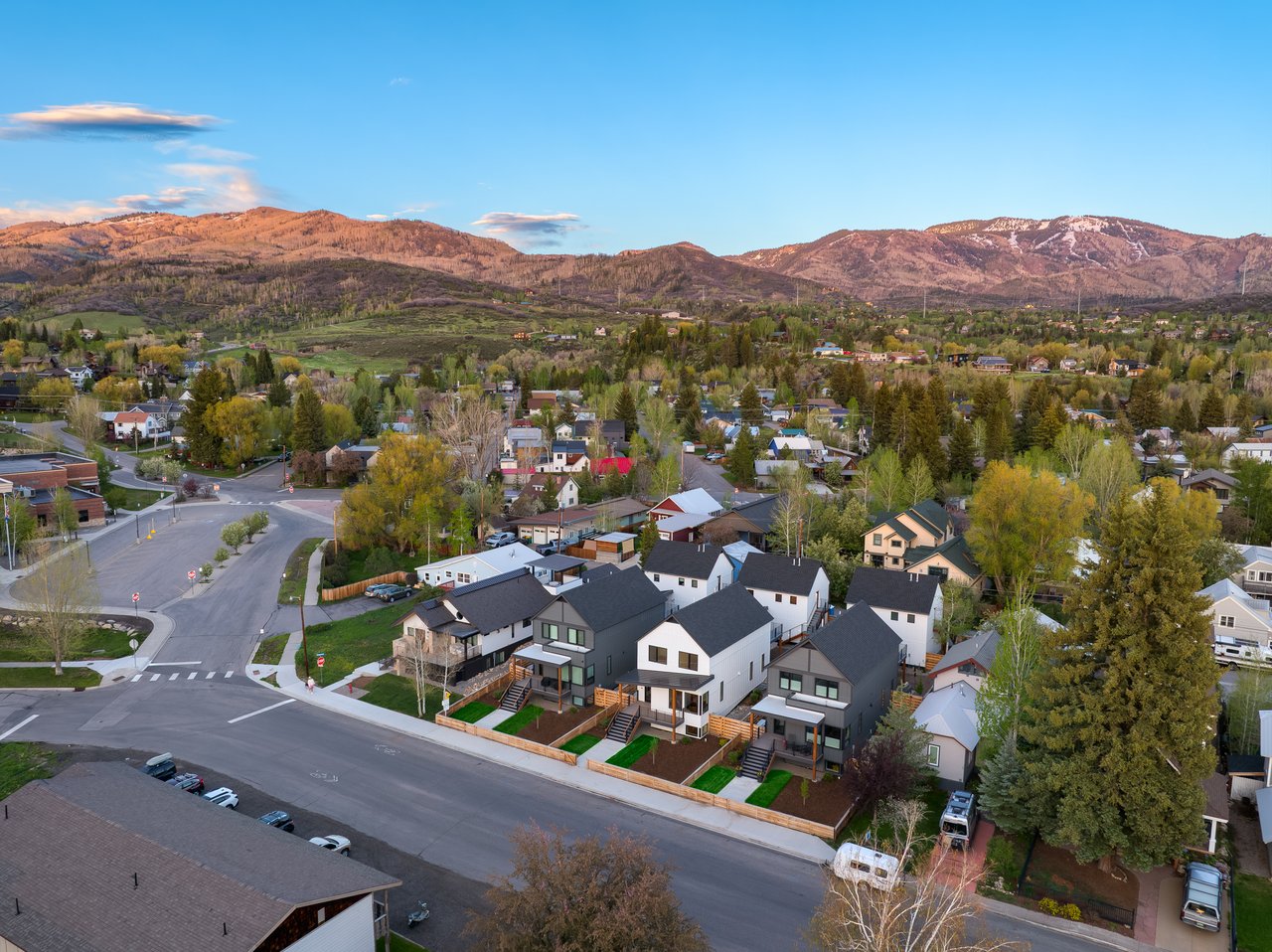
New Development
Three new downtown homes, three closings, and a look at what MR Homes is building next across Steamboat Springs.
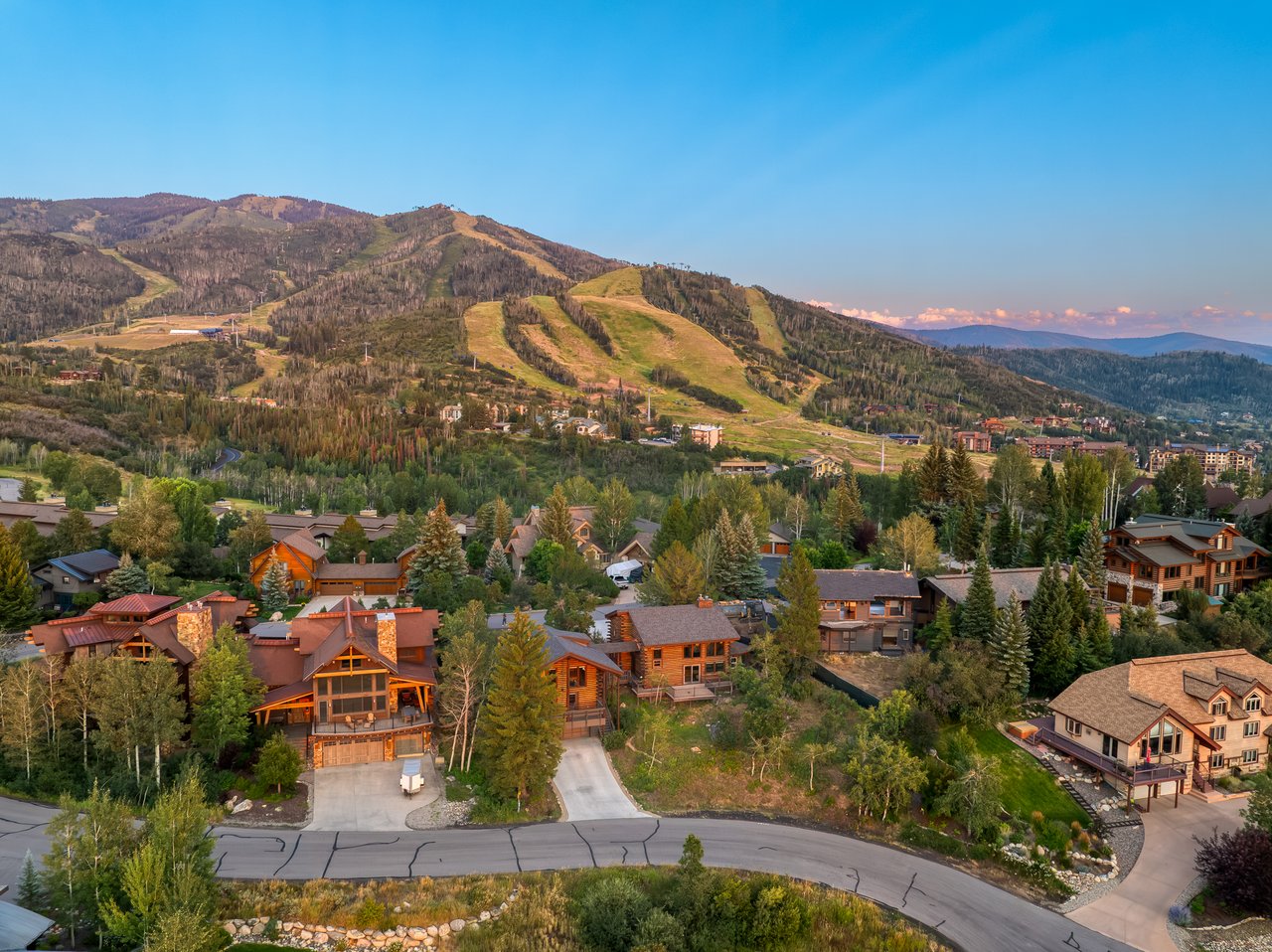
Real Estate
From near-mountain homes to newly built townhomes, how long-term rentals fit a 1031 exchange in Steamboat Springs.
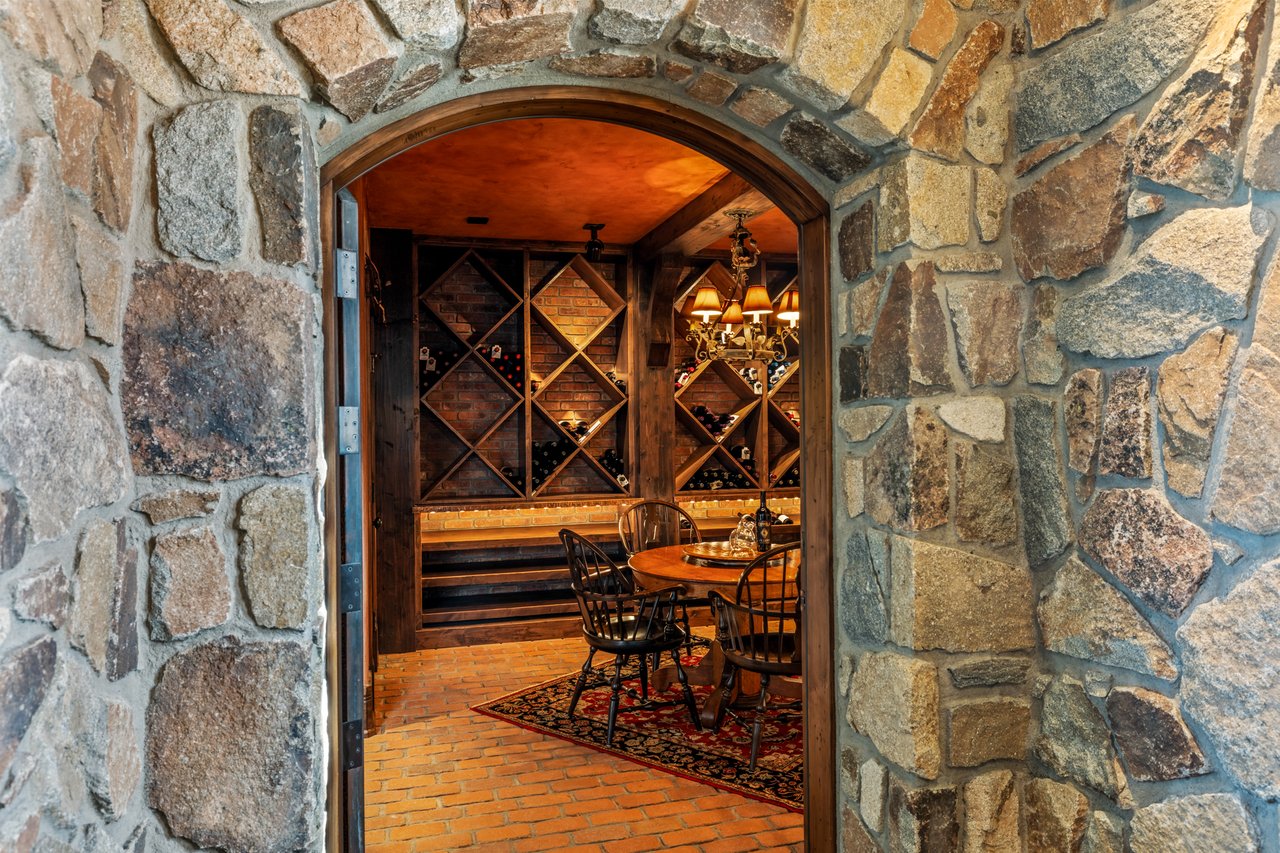
Real Estate
From a brick-walled cellar reached by stone bridge to a New Orleans-inspired bar, at these Steamboat homes, the wine has a room of its own
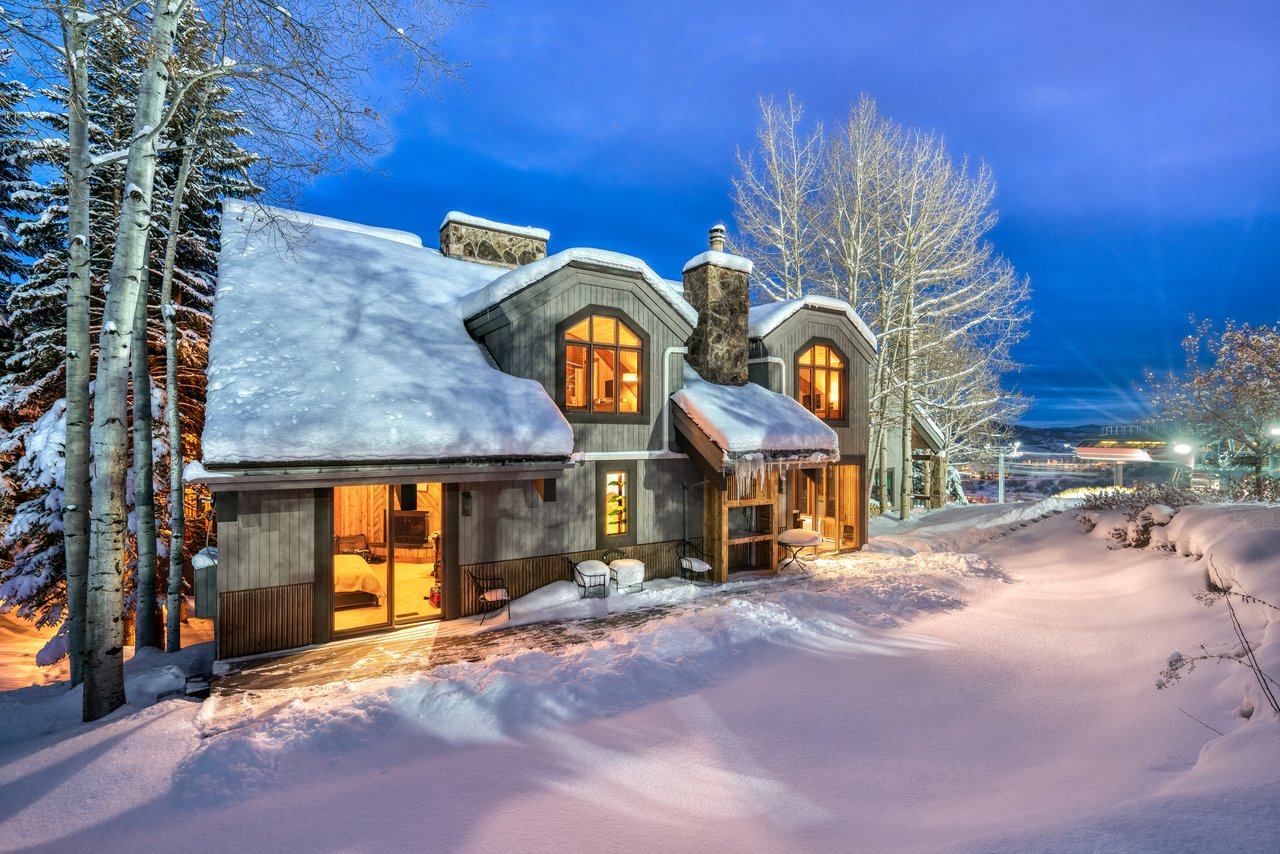
Real Estate
From ski-area condominiums to leased space downtown, a look at how a 1031 exchange works in Steamboat Springs and the properties suited to one.
Real Estate
Slopeside, hillside, and 40 acres outside Oak Creek: the season's newest listings across Steamboat and South Routt
Ski Properties
One of fewer than ten ski-in/ski-out estates on Steamboat Mountain, 3005 Trails Edge is the product of an architect's vision, and an artist's eye for detail.
Ski Properties
The second base-area groundbreaking in less than a month brings 20 private residences and an owners-only club to the hillside above Ski Time Square.

Powderline
From ski-in/ski-out residences to walk-to-gondola townhomes and near-mountain retreats, a look at Steamboat homes positioned for the season ahead.
Experience a level of service that goes beyond transactions. Reach out to our dedicated team today and discover how we combine local insights with innovative solutions to create exceptional real estate experiences in The Agency Steamboat Springs.